
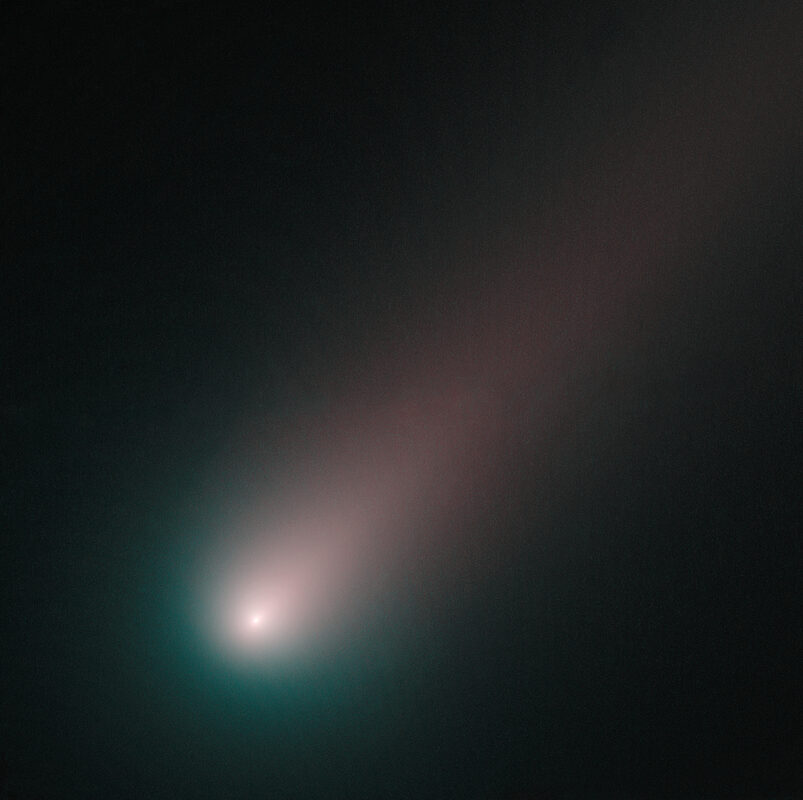
Every comet carries a chemical fingerprint of the cloud it was born in, written in the ratio of ordinary hydrogen to its heavier cousin, deuterium, locked into its water ice. For the interstellar visitor 3I/ATLAS, that fingerprint is strikingly different from anything astronomers have measured in a comet before — and a new modeling study suggests it points to an origin around a star far older and more metal-poor than our Sun.
The study, led by Kenji Furuya of Japan's RIKEN Pioneering Research Institute, was posted to arXiv on Sept. 11, 2026, revised Sept. 14, and has since been accepted for publication in The Astrophysical Journal Letters. The paper's authors — a group spanning RIKEN, NASA, the Paris Observatory, Auburn University, the University of Washington and the University of Bern — set out to explain an oddity flagged in earlier observations of 3I/ATLAS: its water is unusually "heavy."
What the numbers actually say
Deuterium is hydrogen with an extra neutron, and the deuterium-to-hydrogen (D/H) ratio in a comet's water is a proxy for the physical conditions — temperature, radiation, chemistry — present when that ice first formed. In our own solar system, comets typically show D/H ratios around 0.015 to 0.03 percent. 3I/ATLAS measures in at roughly 1 percent, with the paper giving a precise value of (9.8 ± 0.6) × 10⁻³ — meaning its water is enriched in deuterium by a factor of roughly 30 to 65 compared with the comets that formed alongside Earth. The object's methane shows a similar pattern: about 3 percent deuteration, versus roughly 0.2 percent measured in the well-studied solar-system comet 67P/Churyumov-Gerasimenko.
Those aren't small discrepancies. They're the kind of gap that demands an explanation rooted in how and where the comet's ice actually assembled, not just noise in the measurement.
Modeling the birth cloud
To explain the elevated ratio, Furuya's team built gas-ice astrochemical models tracking chemistry across the full arc of star formation — from a diffuse molecular cloud, through a collapsing prestellar core, to the protoplanetary disk stage where cometary ice ultimately locks in. They varied gas density, ultraviolet radiation, cosmic-ray ionization, and — critically — metallicity, the abundance of elements heavier than hydrogen and helium in the birth environment.
The best fit to 3I/ATLAS's observed D/H ratio came from models with subsolar metallicity, at or below about half the Sun's own metal content (≲0.5 Z☉), combined with cloud densities around 10,000 particles per cubic centimeter. The mechanism, as the team describes it, hinges on a molecule called H2D+ — a deuterium-bearing ion that acts as a chemical middleman, transferring deuterium into water and other molecules as ice forms on dust grains. In a lower-metallicity cloud, there's less carbon monoxide around to destroy H2D+, so the ion survives longer and has more opportunity to enrich the surrounding ice with deuterium before it's incorporated into forming ice grains and eventually a comet nucleus.
Why It Matters
3I/ATLAS is only the third confirmed interstellar object detected passing through our solar system, after 'Oumuamua and comet 2I/Borisov. Unlike those earlier visitors, 3I/ATLAS has been bright and active enough to support detailed spectroscopy of its coma — giving astronomers an actual chemical readout rather than just a trajectory and a brightness curve.
That readout matters because interstellar objects are essentially free samples from other planetary systems, delivered without the cost of a spacecraft mission. Most stars and their planet-forming disks are billions of years older than the Sun and formed when the galaxy's overall metal content was lower than it is today — heavier elements accumulate over cosmic time as generations of stars forge and disperse them. A comet with a D/H ratio this elevated is consistent with having formed in exactly that kind of older, metal-poorer environment, long before our own Sun ignited.
If the RIKEN team's interpretation holds up, 3I/ATLAS isn't just a curiosity — it's indirect evidence that the galaxy has been quietly exporting comets from older star systems into interstellar space for eons, and that at least one has now drifted close enough for us to read its ice like a core sample. The finding also gives astrochemists a rare external check on their models of how deuterium chemistry behaves in environments very different from our own solar nebula, since almost everything previously known about cometary D/H ratios comes from objects that formed in one specific place: here.
What's still uncertain
The paper has been accepted for publication in The Astrophysical Journal Letters but is not yet out in its final, published form, and its central claim rests on modeling rather than a direct measurement of 3I/ATLAS's birth cloud, which is obviously unobservable. The subsolar-metallicity scenario is described as the model family that best reproduces the observed ratio, not as a uniquely proven origin story — other combinations of physical conditions in the models could in principle push D/H toward similar values. As with any single-object measurement, there's also no way yet to know how representative 3I/ATLAS is of interstellar comets generally, since it's one of only a handful ever detected.
Still, the consistency between the measured D/H ratio, the independently elevated methane deuteration, and a physically motivated chemical mechanism (H2D+ surviving longer in low-CO environments) gives the low-metallicity origin story more than passing plausibility. Further spectroscopic observations of 3I/ATLAS as it continues its transit, and publication of the RIKEN-led paper in its final peer-reviewed form, should help settle how firm that conclusion really is.
