
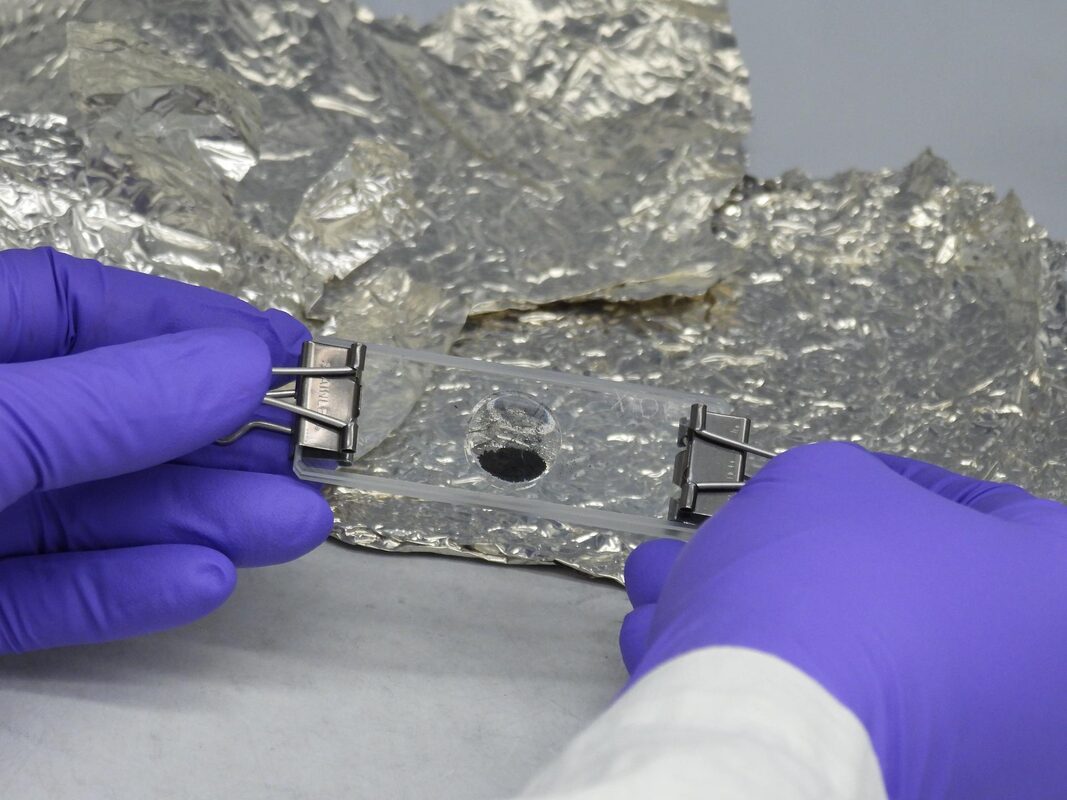
On the morning of July 16, 2024, a daytime fireball shook New York City — bright enough to be seen in full sun, loud enough to be felt. Most such events end with nothing more than a few hundred shaky phone videos and a week of speculation. This one ended with a rock, slightly over two pounds, punching through the roof of a house in Hillsborough Township, New Jersey.
Nearly two years later, on July 15, 2026, an international team reported in Science Advances what that rock has been hiding: salt minerals left behind by ancient brines, and a distinctly alien inventory of amino acids that appear to have been assembled in those same salty fluids more than 4.5 billion years ago.
A rare rock, caught before Earth could ruin it
The Hillsborough meteorite is a CM carbonaceous chondrite — the clan of primitive, carbon- and water-rich stones that planetary scientists prize because they never got hot enough to erase their own history. It is the 22nd observed CM-type fall. But Hillsborough is only the second witnessed fall of a CM1/2 carbonaceous chondrite ever recovered, following the Kolang meteorite that came down in North Sumatra, Indonesia, in 2020.
That subtype label matters. CM1/2 rocks sit at an awkward, informative point on the alteration scale: water worked them over aggressively on their parent body, but not so thoroughly that the record of what the water was doing got wiped out.
The other thing that matters is speed. Carbonaceous chondrites are chemical sponges. Leave one in a field for a season and terrestrial water, soil microbes, and their organic detritus start writing themselves into the sample — at which point any claim about "alien organics" becomes a fight over contamination. Hillsborough got the opposite treatment. The homeowners pulled on gloves, collected the fragments with foil and glass jars, and sealed the damaged roof before rain could arrive and soak into a porous stone. That response sharply limited how much Earth chemistry could bleed in.
The brine story
The mineralogical headline is sodium. The team found high abundances of it, likely from icy brines, and — per NASA's account of the work — identified sodium-carbonate salts sitting inside microscopic fractures in the rock, the first such identification in a CM carbonaceous chondrite. That is exactly where you would expect fluid to have flowed, and exactly what you would expect it to leave behind on its way out.
The reconstruction goes like this. The parent asteroid accreted with ice. Radiogenic heat melted that ice into liquid water, which was never pure to begin with — it dissolved whatever it touched, and grew progressively saltier. As water was lost, the remaining fluid concentrated into brine, and the dissolved salts eventually crystallized out into the cracks where the team now finds them. Small salt-rich CM1 fragments in the sample point to fluids that had become genuinely concentrated. Hillsborough is also, in Jenniskens's description, the first CM-type meteorite containing bits of rock that preserved the subsurface of the original asteroid — the region where those briny fluids did their work.
What makes this more than a mineralogy footnote is what brine does to organic chemistry. Concentrated salt solutions are not a passive backdrop; they change reaction rates, they change which molecules are stable, and — the researchers argue — they can drive the assembly of the molecules that matter for life. The amino acid distribution supports that reading: glycine and other alpha-amino acids are relatively more abundant than their beta-, gamma-, and delta- isomers, a pattern consistent with HCN polymerization and Strecker-cyanohydrin synthesis inside the parent body during an early aqueous alteration phase at moderate temperatures.
How do you know they're not from Earth?
This is the question that has dogged meteorite organics for half a century, and the answer here is elegantly simple. "Most of the amino acids detected in Hillsborough are rare or nonexistent in life on Earth, so they are truly extraterrestrial in origin," said Danny Glavin, one of the researchers.
Earth life is a picky customer. It builds its proteins from a short, familiar list. A contaminating fingerprint, a soil bacterium, a stray blade of grass — all of them would deposit that same short list. Hillsborough's inventory doesn't look like that. It looks like the output of a chemistry that never had to answer to biology, which is precisely what you would expect from abiotic synthesis in a briny asteroid interior. Combined with the rapid recovery, that leaves very little room for the boring explanation.
For context, the team measured Hillsborough against the Murchison meteorite — the carbonaceous chondrite that fell in Australia in 1969 and has anchored the field's understanding of extraterrestrial organic chemistry ever since. The comparison is not a wash: oxalic acid in Hillsborough is less abundant and carries lower 13C than Murchison's, a difference that may reflect distinct isotopic carbon reservoirs in the two parent bodies.
Where it came from
Because the fireball was observed, the rock has something most museum meteorites lack: a return address. The team's likely origin for Hillsborough is the Erigone asteroid family in the inner asteroid belt — a cluster of fragments from a shattered parent object, and the same neighborhood as the asteroid Donaldjohanson, which NASA's Lucy spacecraft visited in 2025.
That linkage is the quiet prize. A meteorite without a trajectory is a sample of "somewhere." A meteorite with one is a sample of a specific place, which means every measurement made on it — the salts, the amino acids, the alteration history — can be mapped back onto a known region of the belt rather than floating free.
Why It Matters
The question of where life's building blocks came from has two competing answers that have never been mutually exclusive: they were made on Earth, or they were delivered to it. Hillsborough is a data point for delivery — but more specifically, it's a data point about the factory.
If concentrated brines on primitive asteroids assemble complex amino acid distributions as a matter of routine chemistry, then the early solar system wasn't just seeding planets with generic organic soot. It was running an extensive, distributed synthesis operation, and every one of the countless carbonaceous bodies that hit the young Earth arrived carrying its output. That reframes prebiotic chemistry from a lucky terrestrial accident into something closer to a default condition of a wet, salty, carbon-bearing rock — and there were a great many of those.
It also raises the value of the witnessed fall as a scientific instrument. Sample-return missions are extraordinary, and extraordinarily expensive. A fireball network plus a fast recovery crew gets you a comparably pristine sample, with a traceable orbit, for the price of a phone call to the homeowner whose ceiling just failed. Hillsborough is the second CM1/2 ever caught this way. The first was six years ago. The bottleneck is not the sky — it's how quickly anyone gets there.
The rock, meanwhile, spent 4.5 billion years waiting for someone to find it. It picked a roof in New Jersey.
Sources
- NASA Study of Pristine Meteorite Adds to Story of Ancient Asteroids — NASA Science
- Alien World Chemistry Found Inside Meteorite That Struck New Jersey Home — SETI Institute
- Alien world chemistry found inside meteorite that struck New Jersey home — EurekAlert!
- Meteorite that crashed into a New Jersey home is a rare solar system fragment — CNN
