
Two things happened in Washington this week that, taken together, tell you more about the U.S. Space Force's trajectory than either does alone. The House Appropriations Committee approved $55.5 billion for the service in its latest defense bill markup. And separately, the Space Force announced it is reopening competition for satellite-control antenna systems — the unglamorous but mission-critical ground hardware that ties its orbital constellation to the humans who command it.
Together, these developments sketch the profile of a military branch that has moved past its founding adolescence and into something more consequential: a service with a large, institutionally supported budget and an acquisition machine accelerating to spend it.
What the Committee Approved — and Why It's Not Yet Law
The $55.5 billion figure emerges from a markup session, the legislative stage at which a committee reviews, amends, and votes on a spending bill before it advances to the full chamber. A committee-approved number is meaningful — it reflects the priorities of the lawmakers who write defense appropriations — but it is not yet an enacted appropriation. The bill must pass a full House vote, pass the Senate in its own version, and survive conference reconciliation before it becomes law. Defense appropriations bills are also frequently passed late, sometimes bundled into continuing resolutions that hold spending at prior-year levels while negotiations continue.
Still, what a markup tells you is where a committee's priorities lie. A figure of $55.5 billion is not an accident of arithmetic. It represents a deliberate set of choices by appropriators about how much the U.S. military should invest in the space domain. Commanding that level of committee attention is a marker of institutional legitimacy that no press release can manufacture.
Ground Control: Why Antenna Systems Matter More Than They Sound
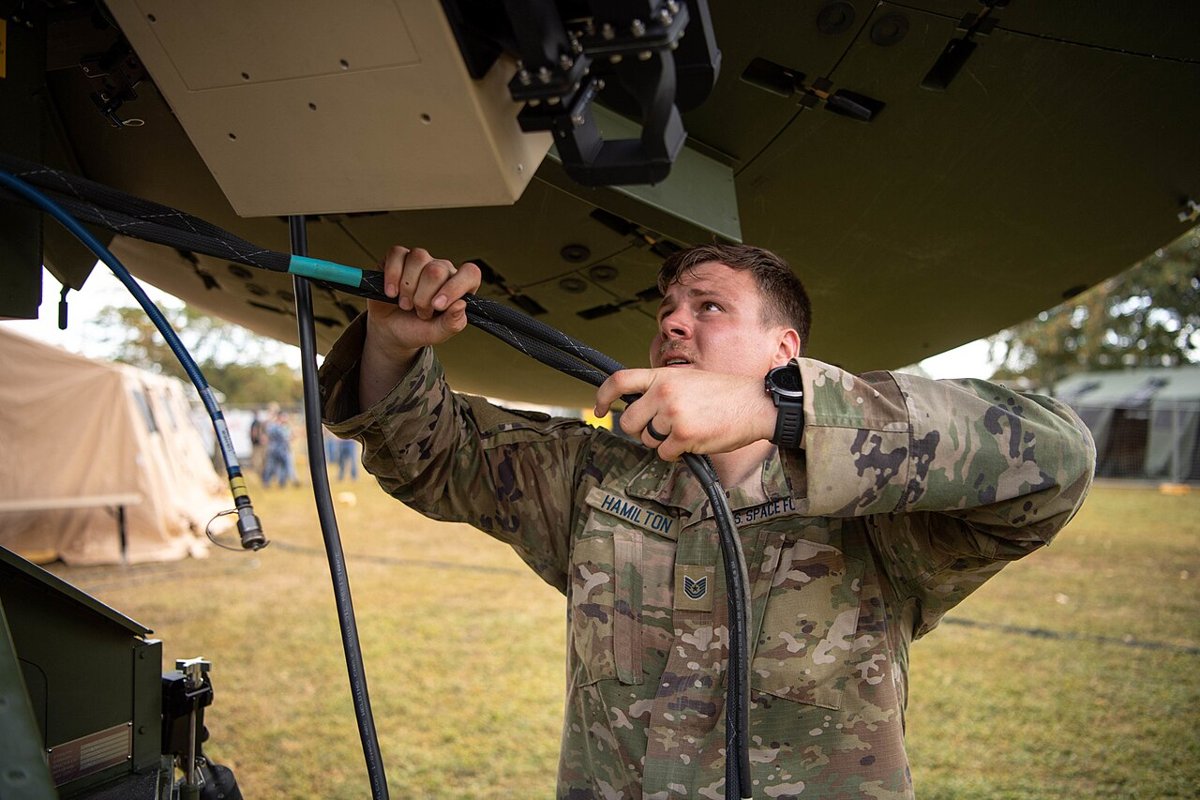
While the budget number makes the headlines, the antenna competition might tell you more about where the Space Force is actually focused. The service is seeking fresh bidders for satellite-control antenna systems — the dishes, receivers, and associated electronics that make up the ground segment of space operations.
The space sector loves to talk about satellites. Satellites are photogenic. They launch on rockets, they orbit at dramatic velocities, they do things that make for good press briefings. Ground antennas do none of that. They sit on the surface of the Earth and point upward, and when they work well, nobody notices. But ground infrastructure is the operational interface between space policy and space capability. A satellite that cannot be reliably commanded, whose data cannot be reliably downlinked, is a satellite that is not contributing to mission effectiveness.
The Space Force's decision to reopen this competition — actively seeking new bidders rather than staying with an existing contract structure — signals that the service wants to reset the acquisition environment around this requirement. Reopening a competition can mean several things: broadening the bidder pool to introduce new entrants, incorporating updated technical specifications that were not in the original solicitation, or correcting earlier bid terms that drew insufficient response. What it clearly indicates is that the Space Force is not treating ground modernization as something to be addressed after satellites and launch vehicles. It is a near-term acquisition priority, running in parallel with the largest budget discussions the service has ever had.
A Budget Environment Under Pressure
The Space Force and NASA both operate within the same federal space policy framework and must navigate appropriations within the same broader budget environment. They serve different missions — one military, one civil — and they draw from different appropriations accounts. But they share a common political reality: Congress allocates limited dollars to space activities, and both agencies must make their case to the same lawmakers who are simultaneously weighing space spending against readiness, personnel, shipbuilding, and an expanding slate of technology investment priorities.
The $55.5 billion figure for Space Force appropriations exists within a defense budget that encompasses enormous competing demands. Civil space, which funds NASA's science missions and exploration programs, faces its own pressures on the discretionary spending side of the ledger. What happens to Space Force funding in a given year shapes the political space available for civil space priorities, and vice versa — not through direct competition within a single account, but through the aggregate signals that Congress sends about how seriously it takes space as a strategic domain.
The committee's $55.5 billion approval is one of those signals. It suggests that appropriators regard space as a durable defense investment category, not a discretionary line item to be trimmed when other priorities press. That judgment has downstream implications for civil space agencies and commercial operators alike, because it shapes the credibility of long-term space policy commitments across the entire federal space enterprise.
Acquisition Velocity
The juxtaposition of the budget markup and the antenna competition reopen reveals something important about how the Space Force now operates. The service is not pausing its acquisition programs to wait for the legislative calendar to catch up. It is running procurements, refreshing competitions, and advancing ground modernization while the appropriations process unfolds — a posture that reflects confidence in long-term funding and the institutional maturity to manage multi-year programs without requiring a signed appropriations bill to proceed.
This velocity matters because one of the central criticisms of defense acquisition has historically been its slowness — the gap between when a requirement is identified and when capable hardware actually reaches the field. A service that reopens competition on ground antennas while its parent budget bill is still in committee is demonstrating that it intends to compress that gap. Whether that intention translates into delivered capability depends on execution quality, contract structure, and industrial base response. But the structural posture — acquire forward, do not wait — represents a meaningful departure from older defense procurement rhythms that treated budget uncertainty as a reason to pause rather than plan.
Why It Matters
The Space Force is approaching a critical phase in its development. The early years of any new military service are dominated by organizational questions: who reports to whom, what the doctrine is, how to recruit and retain the right people, where the budget comes from. The Space Force has largely worked through those questions, however imperfectly, and is now in a phase where the actual capabilities it fields will define whether the service was worth creating in the first place.
A $55.5 billion committee approval and a reopened antenna competition are two data points in that capability story. The budget signals that Congress believes the Space Force has earned a durable place in national defense planning. The antenna competition signals that the service is translating institutional support into operational infrastructure — the unglamorous, essential work of building out a ground architecture capable of supporting an increasingly complex orbital presence.
What remains to be seen is how the final appropriations number compares to the committee-approved figure, whether the antenna competition attracts the breadth of industry response the Space Force is apparently seeking, and whether acquisition velocity produces delivered capability or merely more procurement process. Those outcomes will become clearer over the months ahead. For now, the trajectory is unmistakable: the Space Force is moving real money, at scale, toward real infrastructure, with a sense of urgency that reflects the stakes of the domain it was created to defend — and it is not waiting for Washington to finish its paperwork before it starts.
