
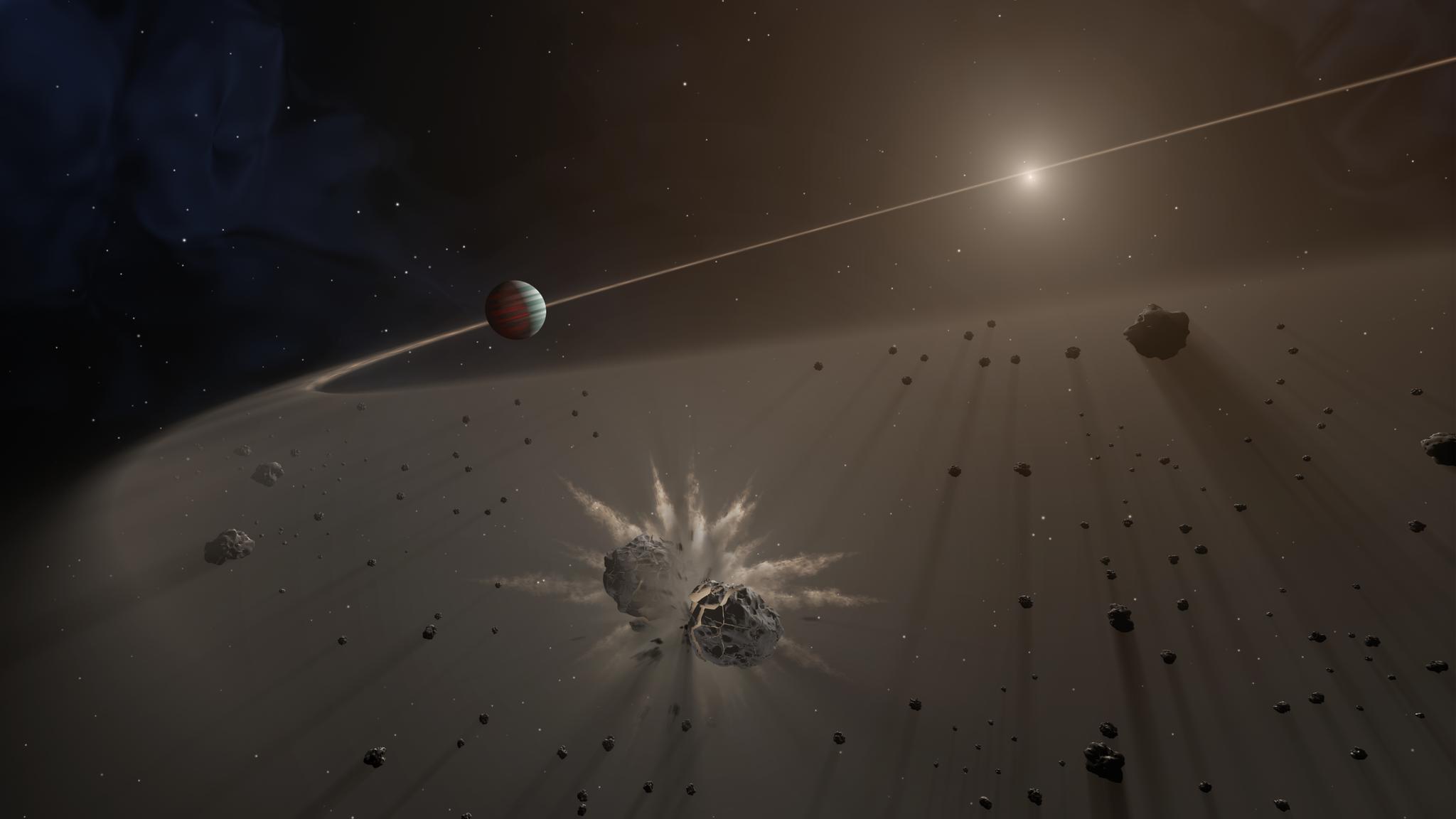
For as long as astronomers have hunted for radio emission from planets beyond the solar system, they have run into the same problem: any signal picked up from a planetary system could just as easily be coming from the star. Stars are noisy at radio wavelengths — flares, coronal activity, magnetic loops snapping and reconnecting — and a planet's own whisper is easy to lose in that racket. On September 15, 2026, a team that included Yvette Cendes of the University of Oregon posted a paper on arXiv reporting that, for the first time, they didn't have to guess. They traced radio bursts directly to a planet.
The target was Beta Pictoris b, a young gas giant roughly ten times the mass of Jupiter orbiting a star 63 light-years from Earth in the constellation Pictor. Using the MeerKAT radio telescope array in South Africa, Cendes' team recorded rapid, recurring bursts of radio emission between 0.85 and 3.5 GHz, along with a fainter persistent signal in the same band. The bursts were highly circularly polarized — a signature that, combined with their timing and spectral shape, identifies them as electron cyclotron maser radiation. That's the same physical process that powers Earth's auroras and Jupiter's much brighter ones, produced when charged particles spiral along magnetic field lines near a planet's magnetic poles.
How They Knew It Wasn't the Star
The distinction matters because the emission mechanism itself points to the source. Electron cyclotron maser radiation is generated at a specific frequency set by the local magnetic field strength — not by stellar processes like flares or coronal mass ejections, which produce broader, less cleanly polarized signals. The recurring, tightly periodic nature of the bursts, paired with the near-total circular polarization, let the team rule out the star as the origin and pin the emission to the planet.
That distinction unlocked something researchers have wanted for years: a direct read on the planet's magnetic field strength. The math is straightforward once you know the emission frequency — the cyclotron maser mechanism radiates at a frequency proportional to the field strength at the source — and it points to a magnetic field of at least 1.25 kilogauss at Beta Pictoris b. For comparison, Earth's magnetic field measures about half a gauss at the surface. Beta Pictoris b's field is at least 2,500 times stronger than Earth's.
"It's an incredibly, incredibly strong magnetic field, much stronger than anything in our solar system," Cendes told Science News in a report published September 21. The planet itself is a beast by solar-system standards too: about ten Jupiter masses, still young and hot from its formation, and spinning fast enough to complete a full rotation in roughly eight hours.
Why a Magnetic Field Measurement Is a Big Deal
Planetary magnetic fields are notoriously hard to measure from light-years away. Inside the solar system, spacecraft can fly through a planet's magnetosphere and measure the field directly with onboard magnetometers — that's how we know Jupiter's and Saturn's field strengths so precisely. For anything orbiting another star, no such flyby is possible, and astronomers have had to rely on indirect proxies, like modeling how a planet's magnetosphere might shape its atmosphere or interact with stellar wind. Beta Pictoris b's radio detection is the first time anyone has measured an exoplanet's field strength directly, from the emission the field itself produces.
Joe Callingham, an astronomer at the University of Amsterdam who was not involved in the study, called it "an incredibly exciting advancement" that, if it holds up in peer review, "would be a fantastic result," in comments to Science News. The reaction from the wider radio-astronomy community has been similarly enthusiastic, not just because of what this one measurement reveals about Beta Pictoris b, but because of what it implies is now possible for other worlds.
Why It Matters
Magnetic fields aren't cosmetic. On Earth, the field deflects the solar wind, which otherwise would slowly strip away the atmosphere — a fate scientists believe befell Mars once its own internal dynamo shut down billions of years ago. A planet's magnetic field is tied up in its interior structure, its rotation, its history, and ultimately its habitability. Until now, exoplanet scientists have had to infer all of that indirectly, through models and analogies to solar-system planets. A confirmed, planet-traced radio detection changes the calculus: it means the technique works, at least for young, massive, fast-rotating gas giants with strong fields. It gives researchers a real data point to calibrate the models that estimate magnetic fields for planets too small or too distant to detect this way directly, and it opens a genuinely new observational channel for characterizing exoplanets that doesn't depend on transits, radial velocity, or direct imaging.
What Comes Next
Beta Pictoris b is, in some sense, an easy case — a young, massive, close-in gas giant with an unusually strong field and a system dusty enough to have made it a favorite target for imaging studies for years. Smaller, cooler, Earth-sized planets present a much harder problem: their magnetic fields, if they have them, are expected to be far weaker, and any resulting radio emission would be correspondingly faint.
That's where the Square Kilometre Array (SKA), the next-generation radio observatory now under construction, enters the discussion. A report published by Universe Today on September 23 argued that the SKA's much larger collecting area and interferometric precision could push this kind of detection down to planets only a few Earth masses larger than Earth, particularly ones orbiting ultracool dwarf stars — faint, cool stars whose planets sit close enough that radio signals might be detectable even from a small, rocky world. The piece drew on both the Beta Pictoris b paper and a chapter from the SKA's own science planning book examining exactly this application. If that pans out, auroral radio detection could become a standard tool for probing whether smaller, more Earth-like worlds have the kind of protective magnetic fields that shield surfaces and atmospheres — a question that bears directly on where else life might have a chance to take hold.
For now, Beta Pictoris b holds a firm claim: the first planet outside our solar system whose magnetic field has been measured directly, and the first whose radio aurora has been heard rather than merely inferred.
