
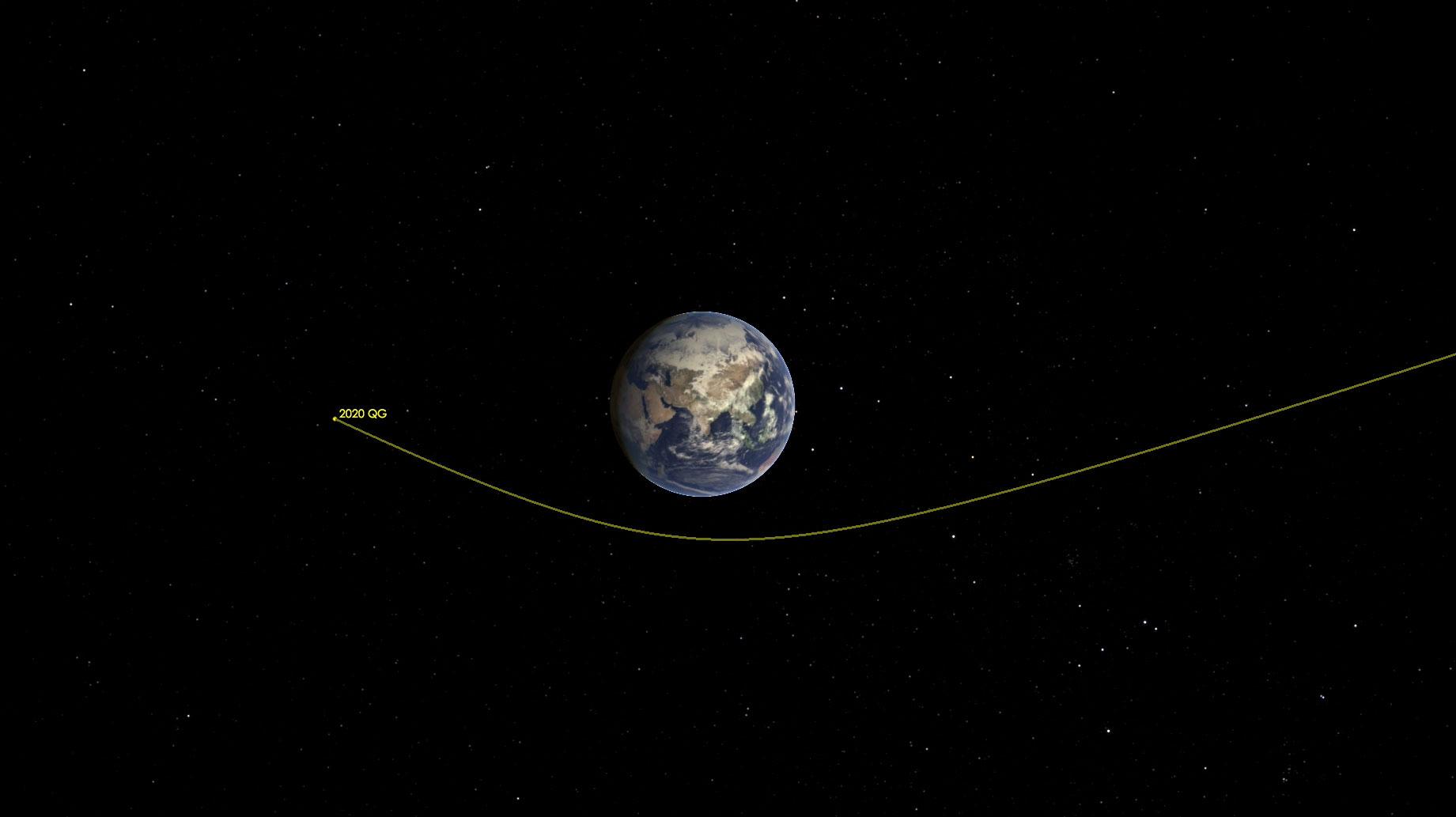
At 16:07 UTC on September 6, 2026, a rock roughly the size of a beach ball slammed into Earth's atmosphere above a stretch of open water northwest of Australia. Nobody on the ground saw it happen — the nearest coastline was hundreds of kilometers away, and the fireball, if it produced one, lit up an empty patch of the Indian Ocean. What makes the event notable isn't the impact itself. It's that astronomers knew it was coming.
The object, designated 2026 RW1, was first picked up by the University of Arizona's Mount Lemmon Survey. From that first detection to atmospheric entry, only 7 hours and 22 minutes elapsed — barely enough time for the observation to circulate, get confirmed, and have its trajectory nailed down before the rock was gone. It is only the 13th asteroid ever spotted in space before hitting Earth, and researchers say it may be the first member of the Aten group of near-Earth asteroids caught this way.
A Short Chase Across a Handful of Telescopes
Once Mount Lemmon's detection went out, the object picked up a temporary designation, CERNQ52, and additional observatories joined in. Pan-STARRS, the wide-field survey based in Hawaii, also contributed observations of the object as its orbit was being pinned down. On the modeling side, NASA's Center for Near-Earth Object Studies (CNEOS) crunched the incoming data to calculate a trajectory and predict the object's impact location — work that has to happen fast, since an object discovered only hours out doesn't leave much room for error correction.
The predicted numbers held up well: ESA's Meerkat system put the median impact position near 13.77°S, 116.43°E, squarely in the remote ocean where the object ultimately came down. Size estimates converged from two directions. Reporting citing the discovery pegged the object at about 0.8 meters (2.6 feet) across, while the European Space Agency, tracking the same object through its Meerkat system, gave a slightly wider range of 0.6 to 1.3 meters (2 to 4.3 feet). Either way, this was never a hazard — an object that small burns up completely in the atmosphere, most likely producing a brief, bright meteor rather than anything that reaches the surface intact.
Why an Object This Small Even Gets Tracked
Objects like 2026 RW1 pose no danger — a meter-class asteroid disintegrates in the upper atmosphere and, at worst, might rattle windows if it happened to come down over a populated area. So why bother catching them at all?
Because they're a rehearsal. Planetary defense agencies don't get many opportunities to test whether their detection and trajectory-prediction pipelines actually work under real conditions — with a real object, on a real clock, against a real outcome that can be checked afterward. ESA's Near-Earth Object Coordination Centre runs a system called Meerkat specifically for this purpose: it scans continuously, around the clock, for potential impacts within a rolling 30-day window, and according to ESA has "successfully identified several imminent impactors." A separate ESA system called Aegis handles the longer view, evaluating potential threats over the next 100 years. Richard Moissl, head of ESA's Planetary Defence office, was the one who publicly flagged 2026 RW1's predicted impact as the tracking data came in.
Small, harmless impactors are exactly the kind of event that lets these systems prove themselves. Every step — initial detection, cross-observatory confirmation, trajectory calculation, predicted time and location, and finally the actual impact — gets checked against reality within hours. There's no ambiguity, no waiting years to see if the model was right.
Why It Matters
Twelve previous asteroids have been detected before hitting Earth; 2026 RW1 makes 13. Each one adds a data point to how fast and how accurately observers can go from "unknown object" to "confirmed impact prediction" — a pipeline that matters far more when the object in question isn't 0.8 meters wide. The tools being exercised here — survey telescopes like Mount Lemmon and Pan-STARRS spotting faint, fast-moving objects; CNEOS and ESA's Meerkat and Aegis systems turning a handful of observations into a trajectory; and the coordination between U.S. and European teams to confirm and publicize the result — are the same tools that would be used if a much larger, genuinely hazardous object were ever found on a similar short-notice trajectory. The fact that 2026 RW1 may be the first Aten-group object caught this way is also scientifically useful: Atens are a specific class of near-Earth asteroids whose orbits mostly lie inside Earth's, making them harder to spot because they tend to appear near the Sun from Earth's vantage point. Catching one before impact, rather than after the fact from debris or eyewitness reports, gives researchers a cleaner test case for that population specifically. None of this changes the risk calculus for the public — meter-scale impactors are a routine, harmless occurrence. But the seven-hour turnaround from discovery to confirmed atmospheric entry is exactly the kind of quiet, unglamorous success that planetary defense systems are built to deliver.
Sources
- ESA - Near-Earth Object Coordination Centre
- Asteroid Detected Hours Before Impact Over Indian Ocean Near Australia Becomes 13th Known Pre-Impact Discovery
- Asteroid 2026 RW1 impacts Earth over Indian Ocean about 7 hours after discovery, becomes 13th known asteroid detected before impact
- Asteroid that exploded over Australia on September 6 might be the first-of-its-kind discovered before impact
